
The Token Trap, Amazon Best Seller, Beating Michael Lewis, The Bitcoin Standard, and a Field of Financial Heavyweights
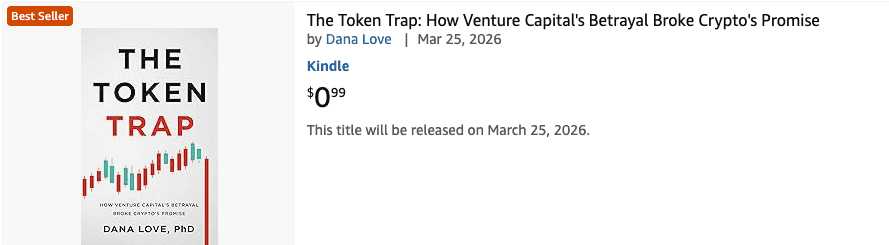
From Hot New Release to Best Seller
Two days ago, The Token Trap debuted at #1 in Amazon Hot New Releases across three categories. Yesterday, it added two more. This morning, the rankings updated again — and the book had moved from Hot New Releases into something different.
Amazon Best Seller. #1. Three categories. Simultaneously.
Two days ago, The Token Trap debuted at #1 in Amazon Hot New Releases across three categories. Yesterday, it added two more. This morning, the rankings updated again — and the book had moved from Hot New Releases into something different.
Amazon Best Seller. #1. Three categories. Simultaneously.
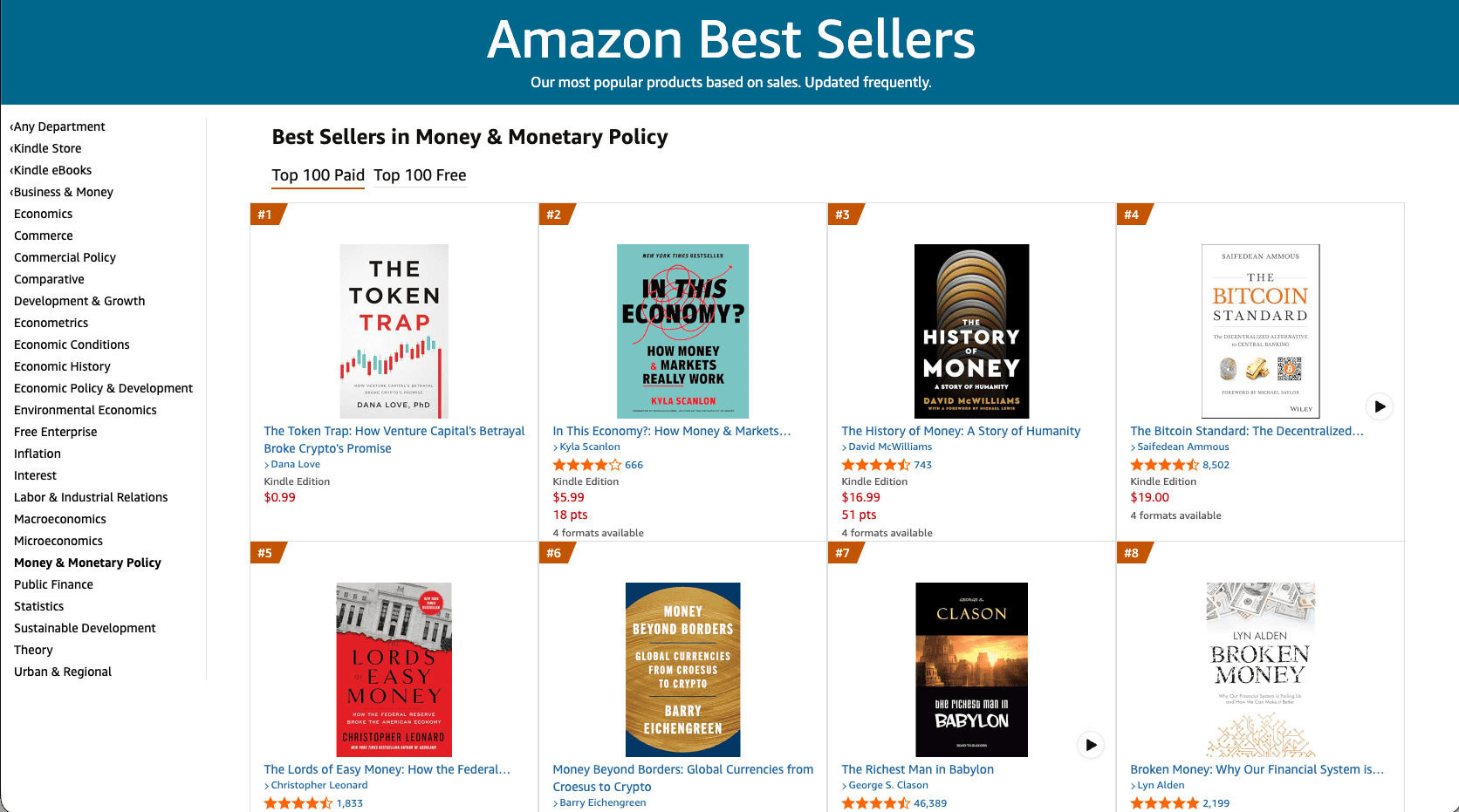
#1 — Amazon Best Sellers in Money & Monetary Policy
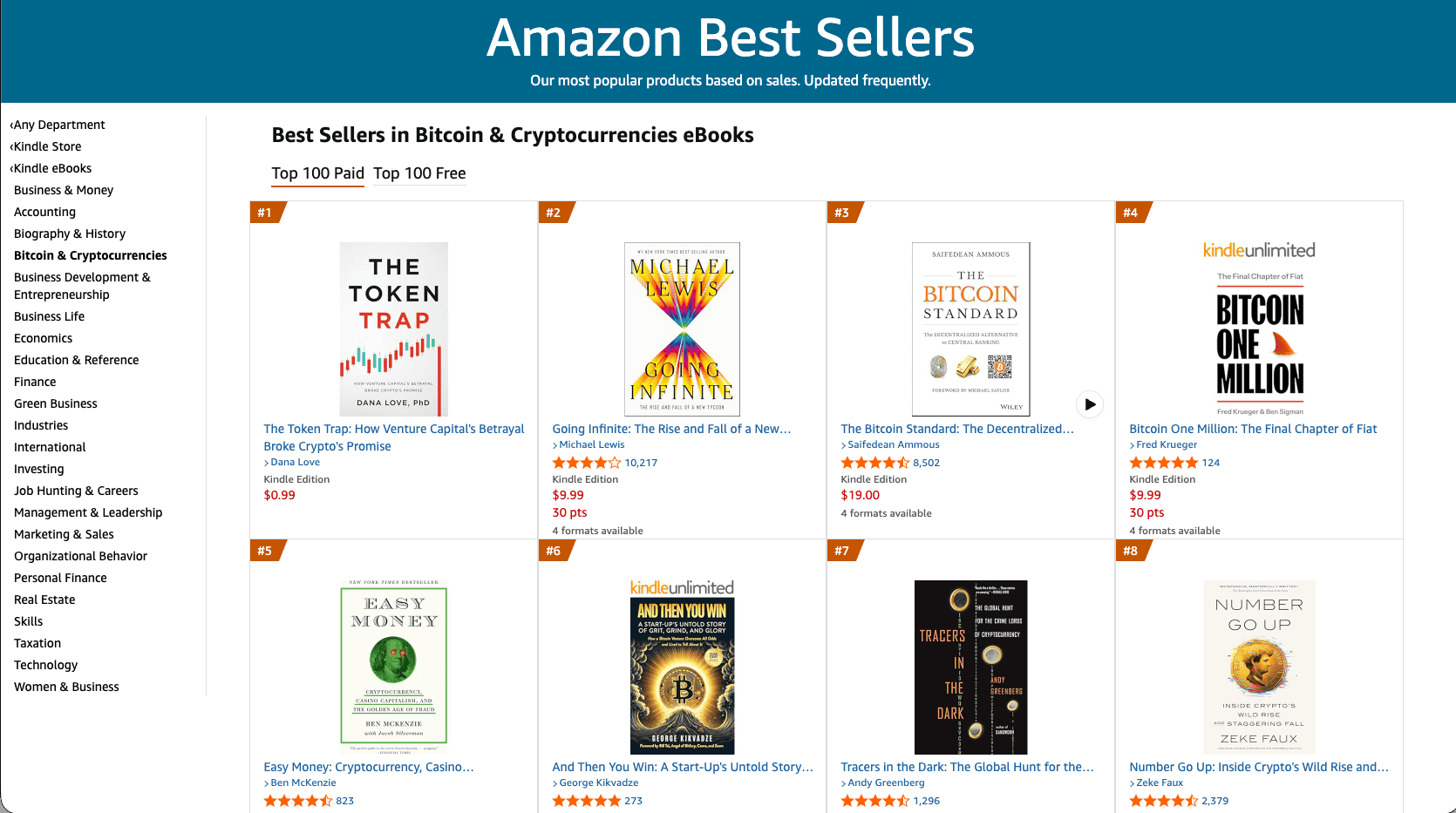
#1 — Amazon Best Sellers in Bitcoin & Cryptocurrencies eBooks
#1 — Amazon Best Sellers in Online Banking

Hot New Releases measures velocity: what’s selling fast among new titles. Best Seller measures something harder: what readers are actually choosing when they look across everything available, new and established alike. These are not the same list, and reaching #1 on the Best Sellers list means outselling books that have been accumulating reviews and momentum for years.
It’s worth taking a moment to look at exactly who The Token Trap outsold to get there, because the company it kept tells you something important about what this book is, who it’s for, and why the thesis is landing the way it is.
What #1 in Money & Monetary Policy Actually Means
The Money & Monetary Policy Best Sellers list is not a crypto list. It is not a tech list. It is one of the most serious categories in financial publishing, the shelf where economists, central bankers, institutional investors, and policy wonks go to understand how money actually works.
On March 10, The Token Trap sat at #1 on that list ahead of:
Kyla Scanlon’s In This Economy?: How Money & Markets Really Work — a New York Times bestseller with 666 reviews, written by one of the most widely read financial educators working today. Scanlon has built a genuine following among people who want serious economic thinking made accessible. Her book has been praised by economists and general readers alike. It was sitting at #2.
Barry Eichengreen’s Money Beyond Borders: Global Currencies from Croesus to Crypto — Eichengreen is a professor of economics and political science at the University of California, Berkeley, a former senior policy adviser to the IMF, and one of the most cited monetary economists alive. His body of work on international monetary systems spans decades. The Token Trap outsold his new book on launch week.
Saifedean Ammous’s The Bitcoin Standard — with 8,502 reviews and years of sustained influence, this is arguably the most important book written about Bitcoin as a monetary system. It has shaped how a generation of investors thinks about sound money. It was at #4.
Christopher Leonard’s Lords of Easy Money: How the Federal Reserve Broke the American Economy — a deeply reported, widely acclaimed examination of how Federal Reserve policy created the conditions for the financial instability we’re living through. Sitting at #5.
Lyn Alden’s Broken Money: Why Our Financial System Is Failing Us — Alden is one of the most respected independent macro analysts writing today, with a dedicated institutional following. Her work on monetary systems is meticulous and influential.
And at #7: The Richest Man in Babylon by George S. Clason — a book first published in 1926, with 46,389 reviews, that has never stopped selling in the century since.
The Token Trap outsold all of them.
I want to be precise about what this means and what it doesn’t. Amazon rankings are snapshots, not permanent verdicts. Eichengreen’s cumulative body of work dwarfs mine. Alden’s macro analysis is essential reading. The Richest Man in Babylon will be read long after all of our new releases are forgotten.
But a ranking is still a signal. And what this particular signal says is that readers interested in how money works, serious readers, policy-minded readers, and economically literate readers are picking up The Token Trap in meaningful numbers. They’re not doing so because it’s a crypto book. They’re doing so because the questions the book asks are monetary questions: Who controls the creation of financial instruments? Who benefits from information asymmetry? What happens when incentive structures are designed to extract value rather than create it? How does a new financial technology get captured by the same intermediaries it was supposed to displace?
These are questions that belong on the Money & Monetary Policy shelf. The ranking confirms that readers agree.
What #1 in Bitcoin & Cryptocurrencies Actually Means
This one requires its own treatment.
The Bitcoin & Cryptocurrencies eBooks Best Sellers list on March 10 included some of the most significant books written about crypto, books by journalists, insiders, and advocates who have collectively shaped how the public understands this industry. The Token Trap reached #1 ahead of all of them.
Michael Lewis’s Going Infinite: The Rise and Fall of a New Tycoon — 10,217 reviews. Lewis is arguably the greatest financial narrative writer alive. Liar’s Poker, The Big Short, Flash Boys, Moneyball — his track record of taking complex financial systems and making them comprehensible and compelling to mass audiences is unmatched. Going Infinite, his account of Sam Bankman-Fried and the FTX collapse, is a masterclass in the form. It was at #2.
Saifedean Ammous’s The Bitcoin Standard — appearing again, at #3, as it has for years on this list. The intellectual foundation for Bitcoin maximalism.
Zeke Faux’s Number Go Up: Inside Crypto’s Wild Rise and Staggering Fall — at #8, a sharp, darkly funny piece of financial journalism that captured the absurdity of the crypto boom with clarity and wit. It’s an excellent book.
Ben McKenzie’s Easy Money: Cryptocurrency, Casino Capitalism, and the Golden Age of Fraud — a prosecutorial account of crypto fraud that made waves when it was published.
I am not going to pretend that I write like Michael Lewis. Nobody does. Going Infinite is a remarkable piece of work, and the fact that it appeared on this list at all, years after FTX collapsed, is a testament to what sustained narrative craft can do.
What I will say is this: Going Infinite and Number Go Up are books about what crypto became. They document the wreckage. The Token Trap is a book about why it became that — the structural forces, the incentive design, the specific mechanisms by which venture capital shaped the industry’s trajectory from the beginning. The question isn’t just “what happened” but “how was this always going to happen given who was funding it and why.”
That’s a different book. And it seems, at least on this particular morning, to be the book a meaningful number of readers wanted.
The Online Banking Signal
The Online Banking category tells a quieter story, but a useful one.
The Token Trap holds #1 there against a shorter list: books on global payments infrastructure, China’s digital currency ambitions, fintech transformation, and blockchain fundamentals. It’s a more specialized audience: people thinking about the future of financial infrastructure, digital payments, and how blockchain technology intersects with conventional banking systems.
Their presence on this list alongside the monetary policy and crypto audiences is not incidental. The Token Trap’s argument runs through all three categories: blockchain was designed to transform financial infrastructure, venture capital shaped how that transformation unfolded, and the result was a system that replicated the rent-seeking behavior it was supposed to eliminate. That argument is as relevant to someone thinking about central bank digital currencies and digital payment rails as it is to a Bitcoin advocate or a monetary economist.
The book found them, too.
Why This Book Connects Across All Three Audiences — and What That Says About the Thesis
Step back from the individual rankings for a moment and look at the pattern across the full launch week.
Over three days, The Token Trap reached #1 in five Amazon Hot New Releases categories — Money & Monetary Policy, Bitcoin & Cryptocurrencies, Online Banking, Finance, and Venture Capital — and then #1 Best Seller in three of those same categories simultaneously.
That breadth is not accidental, and I don’t think it’s primarily a function of marketing. It reflects something about what the book actually is.
Most books about crypto are written for crypto people. They assume familiarity with the technology, the culture, the vocabulary. Most books about venture capital are written for founders and investors. Most books about monetary policy are written for economists or policy audiences. The Token Trap was deliberately written to work across those audiences because the argument requires all three perspectives to be complete.
You cannot understand what happened to blockchain without understanding how venture capital works: not as villainy, but as a rational system operating according to its own logic and incentives. VC funds have fiduciary obligations to their limited partners. They operate on specific return timelines. They need liquidity events. When those structural imperatives met the token economy, where liquidity could be manufactured through token launches rather than waiting for it through traditional exits, the result was predictable to anyone who understood the incentive architecture. The problem wasn’t bad actors. The problem was a system that made certain outcomes structurally inevitable regardless of individual intentions.
You cannot understand the monetary policy implications without understanding the crypto context, how the promise of decentralized, trustless monetary systems collided with the reality that venture capital participation requires centralization, information asymmetry, and the very intermediaries blockchain was designed to eliminate.
And you cannot understand either without the broader financial context: how the same patterns of extraction, capture, and rent-seeking that have characterized traditional finance for generations found new expression in a technology explicitly designed as an alternative.
The readers who showed up in all five categories this week understood something that I hope comes through clearly in the book: this is not a story about crypto. It is a story about financial power, and crypto is its most recent and most instructive chapter.
A Note on Venture Capital
I want to say something directly about the venture capital industry, because The Token Trap has a pointed thesis about it, and I think that thesis is sometimes misread.
This is not a book that portrays venture capitalists as villains. It is a book that portrays them as rational actors operating in an environment that produces irrational outcomes, and that argues that the environment itself requires examination.
VC funds are fiduciaries. They have legal obligations to generate returns for their limited partners. They operate on fund timelines (typically ten years) that create specific pressures around when and how they need to realize gains. When the token economy emerged and offered a mechanism to generate liquidity years earlier than traditional equity exits would allow, the incentive to participate was not greed in any simple sense. It was structural. A VC fund that declined to participate in token launches while competitors captured those returns would have struggled to raise subsequent funds. The incentives were clear, the competitive pressure was real, and the behavior that followed was, in that context, rational.
What I argue in the book is that this rationality, operating at scale across the industry, produced outcomes that were catastrophic for the retail investors, the technologists who believed in the original vision, and ultimately for the technology itself. Rational actors in a poorly designed system can produce collective harm without any individual actor behaving badly by the standards of their own context.
That is a more uncomfortable argument than the villain narrative, because it doesn’t resolve cleanly. It doesn’t give us someone to blame and move on. It requires us to think about system design, about how incentive structures shape behavior, how fiduciary obligations can conflict with broader social goods, and what kinds of reforms could actually change the outcomes rather than just the cast of characters.
I’ve had conversations with venture capitalists who’ve read early chapters of this book and found it fair. I’ve had conversations with others who’ve found it infuriating. Both reactions make sense to me. The book is not trying to be comfortable. It is trying to be accurate.
If you’re a venture capitalist reading this: I suspect you’ll recognize the dynamics I describe. You may disagree with my conclusions. That’s a conversation worth having, and the book is intended to start it.
Key Takeaways
On March 10, The Token Trap reached #1 Amazon Best Seller status. The Token Trap reached #1 on Amazon simultaneously in Money & Monetary Policy, Bitcoin & Cryptocurrencies, and Online Banking.
The sales included a #1 showing among some of the greatest economic works. In Money & Monetary Policy, the book outsold works by Barry Eichengreen, Lyn Alden, and The Richest Man in Babylon — a book with 46,389 reviews published in 1926.
Book sales also debuted past some of the finest writing in cryptocurrency and Bitcoin. In Bitcoin & Cryptocurrencies, it outsold Michael Lewis’s Going Infinite, The Bitcoin Standard, and Number Go Up by Zeke Faux.
New books don’t typically debut at #1, let alone in the broad category reach of The Token Trap. The breadth of the ranking, five Hot New Releases categories, three Best Seller categories across three days, reflects the book’s cross-disciplinary thesis connecting monetary policy, crypto, and venture capital.
The Token Trap looks at the rationality of action in corrupt systems. The Token Trap does not portray VCs as villains. It portrays them as rational actors in a system whose design produces irrational collective outcomes — a harder, and more important, argument.
Get Your Copy!
The Token Trap: How Venture Capital’s Betrayal Broke Crypto’s Promise is available now on Amazon.

About Dana Love, PhD
Dana Love, PhD is a #1 bestselling author, strategist, and operator working at the convergence of artificial intelligence, blockchain, and real-world adoption.
He is the CEO of PoobahAI, a no-code “Virtual Cofounder” that helps Web3 builders ship faster without writing code, and advises Fortune 500s and high-growth startups on AI × blockchain strategy.
With five successful exits totaling over $750M, a PhD in economics (University of Glasgow), an MBA from Harvard Business School, and a physics degree from the University of Richmond, Dana spends most of his time turning bleeding-edge tech into profitable, scalable businesses.
He is the author of The Token Trap: How Venture Capital’s Betrayal Broke Crypto’s Promise — the #1 Amazon bestselling book on Money & Monetary Policy, Bitcoin & Cryptocurrencies, Online Banking, Finance, and Venture Capital (2026) — and has been featured on the cover of Finance World Magazine and Oracle World, in Entrepreneur, Benzinga, CryptoNews, Finance World, top industry podcasts, and is an expert Bitcoin commentator on the business television channel Asharq Bloomberg.
Full Bio • LinkedIn • Read The Token Trap • Buy The Token Trap
Related Articles You Might Enjoy

The Token Trap Claims #1 in Finance and Venture Capital — Five Amazon Hot New Releases in Two Days
The Token Trap: Amazon Hot New Release - Five Categories In Two Days By Dana Love, PhD | March 9, 2026 | 5 min read In This Article: The...
The Token Trap Number One Hot New Release
The Token Trap Debuts #1 on Amazon Hot New Releases By Dana Love, PhD | March 8, 2026 | 5 min read In This Article: Three #1s on Launch...

AI Regulation Debate: Why Grok’s Controversy Matters
AI Regulation Debate: Why Grok's Controversy Matters By Dana Love, PhD | January 20, 2026 | 12 min readThe AI regulation debate reached a...