
Why Algorithmic Stablecoins Are Doomed To Fail
Originally published March 15, 2019 on Medium | Updated for 2025

The Prediction That Came True
In March 2019, I published a warning about algorithmic stablecoins on Medium. My assessment was blunt: they were “intrinsically flawed and doomed to fail.” I argued that relying on arbitrage traders to maintain stability was inviting disaster.
Three years later, in May 2022, Terra/LUNA collapsed in a death spiral that wiped out more than $60 billion in value virtually overnight. The algorithmic stablecoin UST, which was supposed to maintain a $1 peg through algorithmic mechanisms, dropped to pennies. Its sister token LUNA, which backed the system, fell from $119 to fractions of a cent.
The collapse validated every concern I had raised. But here’s what worries me now: algorithmic stablecoins are making a comeback, and the fundamental risks haven’t changed.
Algorithmic stablecoin risks are back.
In This Article:
- The Prediction That Came True
- The Three Types of Stablecoins
- Why Algorithmic Stablecoins Are Fundamentally Flawed
- Game Theory and Behavioral Economics Explain the Failure
- The Terra/LUNA Collapse: A $60 Billion Validation
- The Dangerous Comeback of Algorithmic Stablecoins
- What This Means for DeFi’s Future
- Conclusion: Why the Risks Remain
The Three Types of Stablecoins
To understand why algorithmic stablecoins are dangerous, you need to understand how stablecoins work and what makes them different from each other.
Stablecoins are cryptocurrencies that peg their value to another asset—usually the U.S. dollar. The idea is that whenever someone wants to cash out, they can convert their stablecoin and receive the equivalent amount of dollars. This parity is what, in theory, makes them stable.
The manner of alignment creates three distinct classes of stablecoin:
Fiat-Backed Stablecoins:
- Tied to traditional currency, usually the U.S. dollar
- Tether (USDT) and USD Coin (USDC) are the most prominent examples
- Serve as temporary holding accounts as crypto traders shift between assets
- Issuers are expected to hold sufficient reserves—actual dollars or dollar-equivalents—corresponding to tokens in circulation
Crypto-Backed Stablecoins:
- Collateralized by other cryptocurrencies
- DAI, issued by MakerDAO, is the leading example
- Typically require over-collateralization (150% or higher) due to crypto volatility
- Issuers hold sufficient digital assets to provide adequate liquidation rights
Algorithmic Stablecoins:
- Have no actual reserves backing their peg
- Rely on algorithms, smart contracts, and arbitrage traders to maintain stability
- Terra’s UST was the most prominent example before its collapse
- All seem to align themselves to the U.S. dollar
It’s this third type of stablecoin that is problematic. These algorithmic stablecoins don’t have any actual cash to back their purported peg to the dollar. Instead, they rely on a system of algorithms and arbitrage managed by third-party traders.
Why Algorithmic Stablecoins Are Fundamentally Flawed
The algorithmic model sounds elegant in theory but ignores fundamental principles of economics and human behavior.
Here’s how algorithmic stablecoins are supposed to work:
The Theoretical Model:
- When the stablecoin’s price falls below $1 (too many tokens in circulation, not enough demand), smart contracts automatically kick in
- Excess tokens are taken out of supply and new units of a floating-price token are created
- Traders are incentivized to engage in arbitrage and profit from deviations between the two tokens
- You can always exchange $1 worth of the variable-price token for one stablecoin
So if the stablecoin trades at $0.98, you could buy one, swap it for the floating-price token worth $1.00, and pocket $0.02 in profit. This arbitrage should restore the peg.
The Fatal Flaws:
- Arbitrage traders are manifestly self-interested—they exist to make money now, not later
- The model invites doom by using self-interested experts to provide the stabilizing mechanism
- Game theory shows participants will support the system only as long as their interests align
- Any temporary shift from the peg produces a massively destabilizing effect
Absent knowledge of game theory or behavioral economics, this model sounds divine. But any behavioral economist would caution against relying on arbitrage players to act in the stablecoin’s best interests.

Game Theory and Behavioral Economics Explain the Failure
Absent knowledge of game theory or behavioral economics, the algorithmic model sounds divine. But any behavioral economist would caution against relying on arbitrage players to act in the stablecoin’s best interests.
Arbitrage trading is manifestly self-interested. Traders exist to make money—specifically, to make money right now, not speculative money that might materialize if positive conditions return later. The “long view” for an arbitrage trader is measured in profits made today, not weeks or months from now.
What Game Theory Teaches Us:
- Rational players behave in entirely predictable ways
- Participants will support the algorithmic stablecoin only as long as their interests align with its stability
- This produces a massively destabilizing effect when market conditions cause even temporary deviation from the peg
- The death spiral becomes inevitable once conditions deteriorate
Why the Death Spiral is Inevitable:
- When the peg breaks downward, arbitrage traders face a choice: continue supporting the system at a loss, or exit to preserve capital
- Rational players exit to protect their capital
- Their exit accelerates the decline in value
- More traders see the decline and exit, creating a self-reinforcing spiral
This isn’t speculation—it’s exactly what happened to Terra/LUNA. The behavioral economics are clear: you cannot build a stable system on the assumption that profit-seeking traders will act against their self-interest during a crisis.
The Terra/LUNA Collapse: A $60 Billion Validation
In May 2022, Terra’s algorithmic stablecoin UST began losing its peg to the dollar. What started as a small deviation quickly became a catastrophic collapse.
UST was designed to maintain its $1 peg through an algorithmic relationship with LUNA, Terra’s native token. When UST fell below $1, holders could burn (destroy) 1 UST to mint $1 worth of LUNA, creating arbitrage opportunities that should have restored the peg.
The Timeline of Collapse:
- May 7, 2022: Large withdrawals from Anchor Protocol signal trouble—UST deposits drop from $14 billion to $11.2 billion
- May 9, 2022: UST loses its peg, falling to $0.35 as panic sets in
- May 10-12, 2022: The algorithm mints massive amounts of LUNA to absorb selling pressure—supply explodes from 350 million to over 6.5 trillion tokens
- May 13, 2022: LUNA falls from $119 to $0.00001—a 99.99% collapse in value
What Happened:
- UST fell from $1 to $0.10 as the peg completely broke
- LUNA hyperinflated from 350 million tokens to 6.5 trillion tokens
- The hyperinflation destroyed LUNA’s value, eliminating the arbitrage mechanism
- More than $60 billion in value evaporated within days
- Hundreds of thousands of retail investors lost their life savings
- Some victims took their own lives after losing everything
The collapse validated every warning I made in 2019. The algorithmic mechanism failed precisely because it relied on arbitrage traders to act against their self-interest during a crisis. Once the death spiral began, no amount of intervention could stop it.
The Dangerous Comeback of Algorithmic Stablecoins
Despite Terra’s catastrophic failure, algorithmic stablecoins are making a comeback.
New projects claim they’ve learned from Terra’s mistakes. They tout “improved algorithms,” “better game theory,” or “hybrid models” that combine algorithmic mechanisms with partial reserves.
Why the Risks Haven’t Changed:
- The fundamental flaw remains unchanged—any system relying on arbitrage traders for stability during a crisis invites disaster
- No algorithm can overcome the basic principle that rational actors prioritize self-interest when conditions deteriorate
- Game theory and behavioral economics don’t change just because the code is different
- The crypto industry has a dangerously short memory
The Same Algorithmic Stablecoin Risks Persist Today:
- No actual reserves means no genuine backing during stress
- Arbitrage dependence creates death spiral vulnerability
- Smart contract mechanisms cannot override human behavioral economics
- Retail investors bear the catastrophic losses when systems fail
We’re seeing new algorithmic stablecoin projects raise venture capital and attract users. History is preparing to repeat itself. The push for these projects isn’t driven by sound economics—it’s driven by the venture capital model that prioritizes innovation theater over fundamental soundness.
VCs fund algorithmic stablecoins because they’re novel and defensible, not because they work. The result is predictable: retail investors will bear the losses when the next algorithmic stablecoin collapses, just as they did with Terra.
What This Means for DeFi’s Future
Stablecoins play an essential role in decentralized finance. They provide the stable medium of exchange that DeFi protocols need to function. But not all stablecoins are created equal.
Stablecoins That Actually Work:
- Fiat-backed stablecoins like Tether (USDT) and USD Coin (USDC) maintain real reserves
- Crypto-backed stablecoins like DAI use over-collateralization to ensure stability
- These have weathered multiple market crises because they maintain real collateral backing their pegs
- They provide genuine stability through actual reserves, not algorithmic promises
The Algorithmic Stablecoin Problem:
- They represent existential risks to users and the broader crypto ecosystem
- They offer the promise of decentralization without the burden of reserves
- This promise is built on fundamentally flawed economics
- Each collapse damages trust in the entire DeFi ecosystem
The resurgence of algorithmic stablecoins suggests the crypto industry hasn’t learned the lessons of Terra/LUNA. We’re likely to see another wave of collapses as new algorithmic designs encounter the same behavioral economics and game theory principles that doomed their predecessors.
This connects directly to themes I explore in my book, The Token Trap: How Venture Capital Corrupted Blockchain’s Promise. The push for algorithmic stablecoins isn’t driven by sound economics—it’s driven by the venture capital model that prioritizes innovation theater over fundamental soundness. VCs fund algorithmic stablecoins because they’re novel and defensible, not because they work.
The result is predictable: retail investors will bear the losses when the next algorithmic stablecoin collapses, just as they did with Terra.
Conclusion: Why the Risks Remain
My 2019 prediction about algorithmic stablecoins came true with Terra’s collapse. Unfortunately, I’m predicting it will happen again.
The fundamental risks haven’t changed since I first warned about them. Game theory still governs rational actor behavior. Arbitrage traders still prioritize short-term profit over long-term stability. Smart contracts still cannot override human behavioral economics. And systems without reserves still lack genuine stability mechanisms.
The Unchanging Reality:
- Game theory still governs rational actor behavior
- Arbitrage traders still prioritize short-term profit
- Smart contracts still cannot override human behavioral economics
- Systems without reserves still lack genuine stability mechanisms
What This Means for You:
- If you’re involved in DeFi, stick with stablecoins that have actual reserves
- The elegance of algorithmic mechanisms cannot compensate for their fundamental economic flaws
- No amount of “improved” code can fix a system built on flawed assumptions about human behavior
- Protect yourself by understanding the difference between real backing and algorithmic promises
Until the crypto industry accepts these realities, we’ll continue seeing algorithmic stablecoin projects launch, attract users, and eventually collapse. The only question is how much wealth will be destroyed in the process.
The lesson from Terra/LUNA is clear: algorithmic stablecoins are doomed to fail. Not because of implementation details or code bugs, but because they’re built on fundamentally flawed economics. You can’t build stability on the assumption that profit-seeking traders will act against their self-interest during a crisis.
Learn more about how venture capital corrupted blockchain’s promise in my book, The Token Trap.
Key Takeaways
Algorithmic stablecoins rely on arbitrage traders for stability—a fundamentally flawed design that invites disaster. By depending on profit-seeking actors to maintain the peg during crises, these systems guarantee failure when market conditions deteriorate and rational traders prioritize self-preservation over system stability.
Terra/LUNA’s May 2022 collapse wiped out $60+ billion, validating warnings made three years earlier. The death spiral—from $119 to fractions of a cent—proved that algorithmic mechanisms cannot override basic principles of game theory and behavioral economics when panic sets in.
Game theory shows arbitrage players will always prioritize short-term profit over long-term stability. The “long view” for arbitrage traders is measured in profits made today, not speculative returns if positive conditions eventually return, making them unreliable stabilizers during the exact moments stability is most needed.
New algorithmic stablecoins are emerging despite proven risks, threatening another wave of losses. Projects claim “improved algorithms” and “better game theory,” but the fundamental flaw remains unchanged—no code can fix a system built on the assumption that rational actors will act against their self-interest during crises.
Only fiat-backed and crypto-backed stablecoins with actual reserves provide genuine stability. Tether, USDC, and DAI have weathered multiple market crises because they maintain real collateral, not algorithmic promises. The elegance of code cannot compensate for the absence of actual backing.
The push for algorithmic stablecoins is driven by venture capital’s innovation theater, not sound economics. VCs fund these projects because they’re novel and defensible, not because they work—resulting in retail investors bearing catastrophic losses when the inevitable collapse occurs.
Behavioral economics predicts the death spiral is inevitable once the peg breaks. When prices fall, rational traders exit to preserve capital. Their exit accelerates the decline. More traders see the decline and exit. The spiral becomes self-reinforcing until the system collapses completely.
The crypto industry’s short memory ensures history will repeat itself. Despite Terra’s $60 billion lesson, new algorithmic stablecoin projects continue raising capital and attracting users, setting the stage for the next wave of wealth destruction.
Want to Discuss AI or Web3 Strategy for Your Business?
Schedule a consultation to explore how blockchain and AI can transform your enterprise without the complexity.

About Dana Love, PhD
Dana Love is a strategist, operator, and author working at the convergence of artificial intelligence, blockchain, and real-world adoption.
He is the CEO of PoobahAI, a no-code “Virtual Cofounder” that helps Web3 builders ship faster without writing code, and advises Fortune 500s and high-growth startups on AI × blockchain strategy.
With five successful exits totaling over $750 M, a PhD in economics (University of Glasgow), an MBA from Harvard Business School, and a physics degree from the University of Richmond, Dana spends most of his time turning bleeding-edge tech into profitable, scalable businesses.
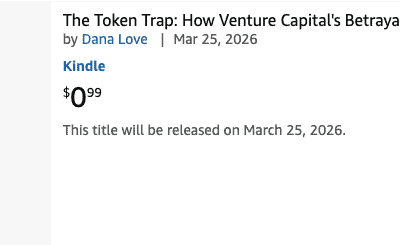
He is the author of The Token Trap: How Venture Capital’s Betrayal Broke Crypto’s Promise (2026) and has been featured in Entrepreneur, Benzinga, CryptoNews, Finance World, and top industry podcasts.
Related Articles You Might Enjoy
The Token Trap: Amazon Best Seller
The Token Trap, Amazon Best Seller, Beating Michael Lewis, The Bitcoin Standard, and a Field of Financial Heavyweights By Dana Love, PhD |...

The Token Trap Claims #1 in Finance and Venture Capital — Five Amazon Hot New Releases in Two Days
The Token Trap: Amazon Hot New Release - Five Categories In Two Days By Dana Love, PhD | March 9, 2026 | 5 min read In This Article: The...

The Token Trap Number One Hot New Release
The Token Trap Debuts #1 on Amazon Hot New Releases By Dana Love, PhD | March 8, 2026 | 5 min read In This Article: Three #1s on Launch...